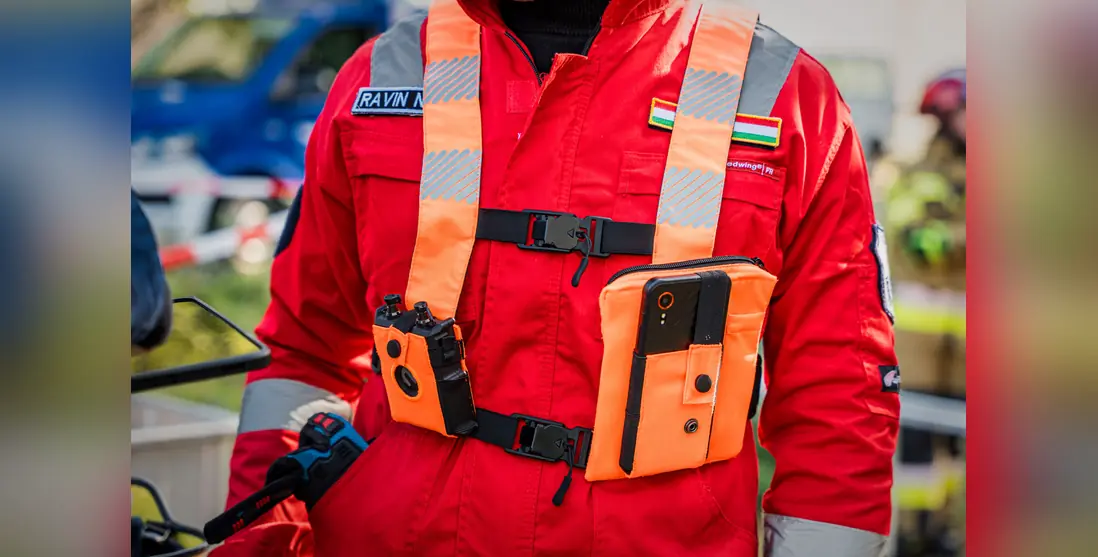
Wearin’ has successfully concluded the final System Field Test (SFT) of SYNERGISE, an international research initiative involving 16 partners working together to develop an integrated technological toolkit for responding to natural and human-induced disasters.
The exercise was conducted from 12 to 16 October 2026 at the Fighting City police training and testing facility in Berlin, Germany. It brought together the technologies developed by all SYNERGISE technical partners to assess their combined performance in a demanding Search & Rescue (SAR) operation.
The exercise recreated a major disaster involving an explosion, several collapsed structures, fire and heavy smoke. The scenario enabled participating organisations to evaluate how connected technologies could support emergency teams operating in dangerous and rapidly changing conditions.
Information collected from robots, drones, wearable equipment and positioning technologies was integrated in real time. This provided first responders with an improved understanding of the incident, helping them identify potential hazards, make informed decisions and coordinate their activities more effectively.
The exercise involved 12 firefighters and emergency responders from Greece, Sweden, Germany, Poland and Kurdistan, all equipped with Wearin’ technology. Their participation allowed the consortium to assess personnel monitoring capabilities in realistic emergency-response conditions.
Wearable technology for monitoring first responder safety
Wearin’ played a central role in the integrated response system by bringing together physiological monitoring and environmental sensing capabilities.
Its solution incorporated several important safety features, including:
- Physiological Stress Index (PSI): Evaluates physical strain using heart-rate and core body temperature measurements.
- Gas detection: Monitors potentially dangerous atmospheric conditions.
- Radiation monitoring: Supports the identification of radiation-related hazards.
- Indoor positioning: Uses SYSNAV magneto-inertial tracking technology to locate responders inside buildings.
- Emergency alerts: Includes Man Down detection and SOS alarms to communicate distress situations.
By combining personnel location information with continuous monitoring of physiological conditions and surrounding environmental hazards, the platform provides incident commanders with a more complete picture of responder safety.
The system also incorporates information supplied by drones and other connected equipment, expanding the situational awareness available to emergency management teams.
All collected information was presented in real time through ASTRIAL’s ENGAGE Command & Control platform. This enabled operational commanders to supervise teams working across different areas and monitor evolving conditions throughout the complex, multi-stage emergency scenario.
Such integrated information can be particularly valuable when emergency personnel are exposed to dangerous conditions and commanders must make rapid decisions to protect their teams.
Converting Physiological Data into Practical Safety Information
One of the main objectives of SYNERGISE is to transform large volumes of technical data into clear information that emergency personnel can use during operations.
As part of this approach, Wearin’ developed its Physiological Strain Index (PSI), which converts multiple physiological measurements into a straightforward score ranging from Level 1 to Level 10. The score indicates the degree of heat-related physiological strain experienced by an individual responder.
To simplify the interpretation of these measurements, several indicators are also combined into an overall risk classification of Low, Medium or High, presented through an accessible dashboard.
This enables team leaders to quickly evaluate the physical condition of individual responders and identify those who might need assistance or should be removed from an operation.
The PSI algorithm has also undergone further refinement and can be customised for individual users. This personalisation helps emergency teams recognise excessive physical strain at an earlier stage and take appropriate preventive action.
Integrating Robotics, Drones and Connected Technologies
Interoperability between different equipment platforms is essential for coordinating emergency response activities. The SYNERGISE exercise therefore assessed the Wearin’ system alongside the technologies developed by the project's other partners.
The integrated setup included:
- ANYmal robotic platforms: Developed by ETH Zurich, these robotic systems supported operations in difficult-to-access environments.
- SNAKE robotic system: A telescopic robotic arm equipped with a camera, developed by Japanese partners, for inspecting and interacting with challenging environments.
- Remote-controlled robotic arm: Designed to manipulate objects and operate valves remotely.
- OWL drones: Equipped with LiDAR technology and developed by a Norwegian research laboratory to support indoor mapping and environmental assessment.
The combined deployment enabled partners to examine how information from different technological platforms could be exchanged and used within a common operational environment.
Commenting on the results, Mathilde Bensimhon, Project Manager and Integration Engineer at Wearin’, said:
“The Wearin’ solution performed reliably throughout the exercise and proved essential in the search and rescue operations in combination with the other technologies developed and tested within SYNERGISE,” said Mathilde Bensimhon, Project Manager and Integration Engineer at Wearin’. “We are very proud to see that Wearin’ proved its reliability and capacity to interface with existing sensors, aggregating data and integrating it into our ecosystem while ensuring reliable data transmission.”