Regional Coverage
Regional Coverage
- Details
- Louise Waters
- Middle East

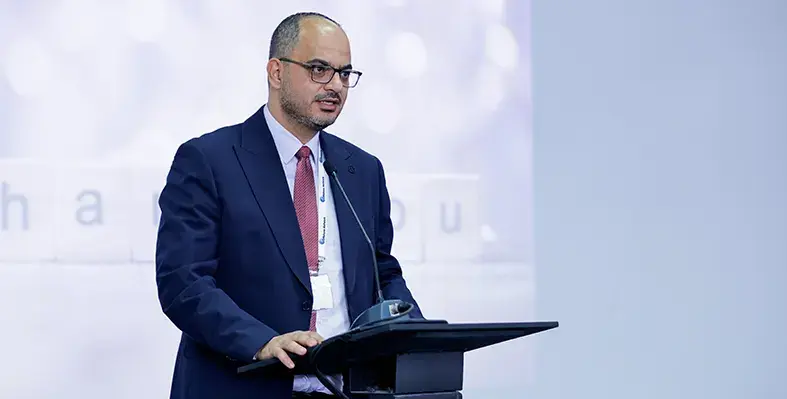
At HSE MENA 2025, held in Dubai, Ihab Al Bairam, AVP Community Management, DAMAC LOAMS, gave a presentation on ‘From compliance to commitment: empowering leaders to shape a proactive safety culture.’
Al Bairam began by highlighting some of the characteristics needed for safety leadership, emphasising the importance of mindset and ownership. In fact it was these qualities that had led him to be promoted from facilities management engineer to his safety leadership role. Safety leaders should also have the ability to transfer the culture of health and safety throughout the organisation.
“Safety is not a policy, it’s a mindset,” he said, stressing the importance of ensuring that the culture of safety as a priority needs to be clearly developed within the organisation and within the core team.
“Once you have that, you need to drive it by showing how the safety culture will benefit your organisation,” he went on. For example, by reducing incidents, motivating employees, improving performance and enhancing efficiencies by making processes leaner and more proactive.
“This will help to justify your operations and processes to the board as well as your team on the ground. It is critical for there to be an understanding of the benefits and drive behind the safety culture which you are trying to establish within the organisation. “
Establishing such a culture is a collective responsibility, he went on. “You can’t act like a one-man show, you need a team behind you which believes what you are building and trying to drive within the organisation. Each team member should have his role, responsibility and accountability for you to achieve your targets.”
Driving the safety culture
Elaborating on the role of safety leadership, Al Bairam went on to highlight four elements needed for a leader to be able to drive the safety culture. The first is to have a vision and mission, the second is to be a role model, who is visibly developing the health and safety culture within the organisation. Third is the need to ensure that rules and responsibilities are made clear throughout the organisation “so each team member knows his responsibilities, what he needs to do, where he needs to act and how he should perform to ensure that health and safety along with day-to-day operations is running smoothly.” Fourth is open communication and reporting. “Your door should be open for team members to report both big and small things. That way, they feel their concerns are acknowledged and listened to.
“Safety culture is not about health and safety processes and procedures, it’s around how we should develop the culture within our team and our organisation,” he stressed.
For the safety culture to be disseminated throughout the organisation and to all its stakeholders, key factors needed are leadership commitment, training and awareness, accountability and transparency of communications, keeping up with technology and market developments, recognition and rewards, continuous learning, development and improvement of processes.
Empowering teams
Al Bairam went on to discuss how to build and improve safety culture across the organisation.
“We need to ensure we are empowering our operations team – not the managers and engineers but the supervisors, workers, technicians, cleaners, security; those are the people who are our eyes on the ground,” he said.
Speaking about DAMAC Properties he said, “Today we are managing around 100 builds across Dubai, and the main eye we have is the security. If I didn’t empower the security to take the right decision, if I didn’t providing them with the training and the processes, our health and safety would collapse. A small fire could spread within minutes if the security didn’t know how to act. The same thing if the cleaner saw the fire and ran away without reporting it.
“Empowerment is not just about delegating responsibility, we need to give guidelines, tools and training on how to act in an emergency.”
He also highlighted the need for integration between operations and health and safety, which can be built through strong processes across the teams, and collaboration and trust between the operations and health and safety teams. “Our organisation has this integration in its DNA,” he said.
“Now we understand health and safety culture and how it should be developed within the organisation, to get to the next level, we need to have a proactive mindset,” he continued.”To develop this we need to encourage open discussion and ensure that near misses are given as much attention as accidents and incidents. Training and continuous learning will also help the team to think proactively to prevent failures.”
Giving more insight about how to empower teams, Al Bairam gave the example of the issue of a work permit, which does not necessarily need to be issued by the health and safety expert, but can be issued by the technician on the ground if he is trained and empowered to do this. “This can happen if you have the right health and safety culture and the leader who is empowering the staff to have the health and safety culture within their organisation, where all the employees within the organisation act like a health and safety officer. We can have this by having training, setting accountability rules and responsibilities, having a proper process and encouraging open communications allowing them to raise their questions and concerns without hesitation.”
On recognition he said, “We need to see the technician the cleaner, the security who is actively protecting our assets to be recognised.”
Finally he stressed that the health and safety leader should push hard to ensure that his function is regarded as a key role rather than a support function, by demonstrating the benefits he brings to the organisation.
“You need to push yourself as a main and core key player within the organisation to have the health and safety culture run across the operation.”
- Details
- Sania Aziz
- North America
The U.S. Department of Labor has unveiled a federal initiative aimed at expanding registered apprenticeship programs in advanced manufacturing, with the goal of enhancing workforce training and promoting safer job performance in high-risk industrial sectors, according to Occupational Health & Safety.
The programme, administered through the department’s Employment and Training Administration, encourages employers to create and expand apprenticeship pathways that prepare workers for skilled manufacturing roles.
These roles often involve operating complex machinery, handling hazardous materials, and performing safety-sensitive tasks, where comprehensive training is critical to preventing workplace injuries and illnesses.
Labor officials said the initiative will prioritise structured, competency-based training combining paid on-the-job learning with classroom instruction. Core elements of these apprenticeship programs include safety fundamentals, hazard recognition, and regulatory awareness, ensuring workers are prepared before undertaking high-risk tasks.
“From an occupational health and safety perspective, expanded apprenticeship opportunities can help reduce workplace incidents by providing employees with consistent, standardised training,” the publication noted.
Manufacturing is considered one of the nation’s more hazardous industries, and safety advocates have long highlighted gaps in training as a key contributor to accidents and near misses.
The department also highlighted that the initiative aims to strengthen the talent pipeline for manufacturers while fostering safer and more resilient workplaces. Employers participating in the program are encouraged to align training with industry standards and evolving safety requirements, ensuring workers remain equipped to meet the demands of modern manufacturing environments.
Officials described the initiative as part of a broader strategy to invest in workforce development while reinforcing protections for employees entering demanding industrial settings. By combining skills development with safety-focused education, the program is expected to support both operational efficiency and a culture of workplace safety across the manufacturing sector.

- Details
- Sania Aziz
- Middle East
Qatar’s Ministry of Labour has conducted a series of roundtable meetings with key stakeholders from the construction sector and beyond, in an initiative aimed at enhancing workplace safety standards, according to Health and Safety International.
The sessions brought together representatives from Building and Wood Workers' International (BWI), government entities, civil society organisations, employers, workers’ representatives, and the International Labour Organisation (ILO). Senior officials attending included undersecretary H E Sheikha Najwa bint Abdulrahman Al-Thani and assistant undersecretary for Migrant Labour Affairs H E Hamad Faraj Dalmouk, alongside several departmental directors.
Central to the discussions was the development of safe and supportive working environments for construction workers, with a particular focus on wellbeing. The initiative aligns with Qatar’s efforts to meet the objectives of the Qatar National Vision 2030 and related Sustainable Development Goals.
The meetings, reported by Health and Safety International, focused on enhancing dialogue and exchanging ideas on issues affecting the construction sector. Discussions included national labour laws, international standards, and strategies for improving occupational safety and health, alongside strengthening workers’ rights.
Sheikha Najwa bint Abdulrahman Al-Thani emphasised that the roundtables reflected Qatar’s commitment to fostering strategic partnerships, sharing global expertise, and advancing labour policies in line with international standards. She noted that the participation of senior officials, experts, and social partners, alongside BWI representatives, provided opportunities to explore innovative solutions to the sector’s challenges.
Key topics addressed during the sessions included labour legislation, occupational safety and health standards, and methods to create a fair and sustainable working environment. The discussions underscore the central role of Qatar’s construction sector in the country’s development agenda and its significance in supporting the state’s major infrastructure and development projects.
By facilitating such engagement, the Ministry of Labour aims to drive improvements in occupational safety, strengthen workers’ rights, and promote a safer and more productive construction sector across the country.
- Details
- Matthew Hayhoe
- Middle East
At the HSE KSA 2025 conference in Riyadh, Larry Wilson, founder of SafeSmart International and a globally recognised authority on serious injury and fatality (SIF) prevention, challenged one of the most deeply ingrained phrases in workplace and public safety culture: “Be careful.”
“It doesn’t matter what language,” Wilson told delegates. “It’s been used by parents for thousands and thousands and thousands of years.” Yet despite its universality, he argued, it has consistently failed to prevent injuries — both at home and at work.
Wilson illustrated the paradox with a personal anecdote from early in his career. Visiting an oil company that proudly showcased its comprehensive safety management system, he recalled being handed a red binder containing “all of the rules, procedures and the different 23 elements in their health and safety management system.” Despite this, the safety professional stressed that employees still needed to be told to be careful.
“When I asked, ‘How do you teach them how to be careful?’ he said, ‘We tell them they need to be careful,’” Wilson said. “We all know it didn’t work for us. So why are we saying the same things to our children? Why are we saying the same things to our workers?”
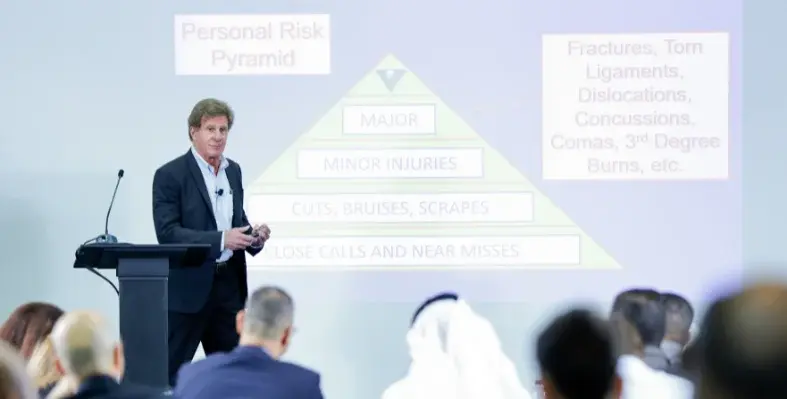
To answer that question, Wilson led the audience through what he described as a “personal risk pyramid” — an exercise he has now conducted with more than five million people across 76 countries. While organisations tend to focus on recordable injuries and lost-time incidents, Wilson urged delegates to consider the thousands of minor, unreported injuries that occur over a lifetime: cuts, bruises, bumps and scrapes.
“Most little kids have got somewhere between ten and 20 visible cuts, bruises, bumps and scrapes on them per week,” he said. “That’s 5,000 by the time we’re twelve.” When viewed this way, the traditional belief that serious injuries are largely the result of bad luck begins to fall apart.
“If it was ten to one, you could say random chance or luck,” Wilson explained. “At a thousand to one, we all know we should have been looking for an assignable cause.”
That assignable cause, he argued, is not equipment failure or the actions of others — factors that account for only a small percentage of serious injuries — but the individual themselves, particularly when their attention is compromised. “Over 90% of the serious injuries… it wasn’t the equipment or the other guy that was the unexpected event,” Wilson said.
The crucial distinction, however, is why people make these errors. According to Wilson, the problem is not carelessness but neurobiology. “To always be thinking about safety is neurologically impossible,” he said. As people become competent at a task, their brains automatically shift into what he described as the first stage of complacency — a state in which the mind begins to wander without conscious permission.
This process is driven by the reticular activating system, which filters out familiar stimuli to conserve energy. “When people become competent, they will also become complacent,” Wilson noted. “We need competence. But with the competence will come complacency.”
This is where Wilson’s concept of “eyes on task” becomes critical. While people may be mentally distracted, maintaining visual attention allows them to benefit from their reflexes — a powerful but often overlooked protective factor. “If you don’t see it or you don’t see it coming, you’re not going to get the benefit of your reflexes,” he warned. “And for that moment you will be defenceless. And that is when the majority of serious injuries and fatalities occur.”
Wilson emphasised that many fatal incidents do not happen during high-risk tasks but during routine, mid-level activities where vigilance is lowest. “The majority of serious injuries and fatalities occur in the middle,” he said, calling this reality “counterintuitive” but statistically well established.
Rather than telling people to “be careful” or “think safety,” Wilson advocated for teaching specific, observable habits that keep eyes on task. These include testing footing or grip before committing weight, moving eyes before hands or feet, and checking line-of-fire hazards. “Those are actually doable,” he said. “It’s almost impossible to ask people to work on five things at once. So pick the one that would help you personally the most.”
Equally important is learning to self-trigger during moments of rushing, frustration or fatigue — conditions that can cause what Wilson described as an “amygdala hijack,” where stress hormones override rational thought. “As soon as you realise you’re rushing or frustrated or tired, you’ve got to quickly think: eyes, mind, line of fire, balance, traction, grip,” he said.
Wilson concluded with a clear call for change. “We need to change ‘be careful’ to ‘keep your eyes on task,’” he told delegates. “And we need to teach people how to self-trigger on the active states so they don’t make a critical error in the moment.”
For safety leaders seeking to reduce serious injuries, Wilson’s message was unequivocal: effective prevention lies not in slogans or reminders, but in aligning safety systems with how the human brain actually works.

- Details
- Matthew Hayhoe
- Middle East
After introducing new licensing requirements for workers in energy and mining, the Oman Ministry of Labour has now urged "all establishments to expedite compliance with the licensing requirements" ahead of the end of the 'correction period', which ends on June 1st, 2026
A notice issued on the Oman Ministry of Labour's website established the list of 43 relevant professions that must adapt to new licensing procedures. From June 6th, 2025, new work permits will not be issued to those without licenses.
Among the listed professions is HSE Advisor, Forklift and Excavator Operator, Vehicle Marshaller and Lifting Supervisor. A full list can be found on the Oman Ministry of Labour guidance.
During the correction period, work permits may be issued and renewed even if workers have not yet applied for the license.
Licenses must be applied for and claimed via the Omani Association for Energy and Mining Skills. Licenses certify national competencies and are designed to regulate the labour market, ensuring employees meet certain criteria.

- Details
- Matthew Hayhoe
- Europe
The European Agency for Safety and Health at Work (EU-OSHA)'s new report analyses the physical and psychosocial demands placed upon home carer, which it reported as one of the lowest-paid occupations in the European Union
William Cockburn, EU-OSHA's executive director, introduced the report. "Home care workers are the invisible backbone of our care systems. They support our most vulnerable citizens, yet they often do so under precarious working conditions.
"This report shows that with the right preventive strategies and initiatives, we can make home care work safer and healthier."
Common health problems reported as particularly common among home care workers included musculoskeletal disorders, often attributed to lifting and awkward postures required while at work, and mental health issues like stress and isolation.
The report is part of EU-OSHA's wider 'Health and social care and OSH' project, which is conducting research across the home care sector to spotlight the risk assessment and prevention gaps that have become commonplace.
EU-OSHA also commented on the sector's reliance on migrant workers, with this particular demographic at even greater of risk due to their often precarious employment and migration status.

- Details
- Louise Waters
- Middle East
Qatar Ministry of Labour’s Occupational Safety and Health Department, in cooperation with Qatar Foundation, Tadmur Contracting, and The Westin Doha Hotel & Spa, has held three awareness seminars for workers and employers' representatives on the prevention of workplace hazards
The aim was to raise awareness of the importance of implementing occupational safety standards and guidelines, and of methods to reduce accidents, injuries, and exposure to biological agents. The seminars are part of the Ministry of Labour's ongoing efforts to promote a safe and healthy working environment across worksites in the country, and to raise awareness of the importance of adhering to occupational safety procedures and adopting proper behaviours while carrying out duties in the contracting, construction, and hospitality sectors.
Experts from the Occupational Safety and Health Department, the Ministry of Public Health, and the Workers' Support and Insurance Fund delivered presentations to workers, outlining the most prominent risks in workplace environments such as slips, trips, and falls from heights; working on scaffolding; injuries resulting from the use of heavy machinery; trench collapses; exposure to contaminated materials; and behaviours that may contribute to the spread of infectious diseases. They also highlighted best practices to avoid these risks.
The experts stressed that reducing injuries and accidents at construction sites and avoiding biological hazards requires compliance with approved preventive measures, such as the use of personal protective equipment, adherence to on-site safety guidelines, ensuring equipment is safe before use, maintaining general hygiene, complying with sterilisation procedures, and adopting healthy behaviours to avoid potential sources of infection. They also emphasised the importance of employers' role in providing a safe work environment free from injuries and hazards.
These seminars are part of a series of awareness programmes and activities implemented by the Ministry of Labour throughout the year, in cooperation with partners in the public and private sectors, with the aim of enhancing occupational safety and health awareness, informing workers and employers of their legal obligations, and promoting compliance with the best local and international standards to ensure a sound and healthy working environment that provides the highest levels of protection and care for all workers in the country

- Details
- Sania Aziz
- Middle East
The Board of Directors of Bahrain's Labour Market Regulatory Authority (LMRA) recently convened its regular meeting, chaired by His Excellency Yousif bin Abdul Hussain Khalaf, Minister of Labour and Minister of Legal Affairs. The session was attended by board members and Noubras Mohammed Talib, the LMRA's Chief Executive Officer.
A key focus of the meeting was reviewing the LMRA's ongoing efforts to implement strategic plans designed to strengthen the work environment and enhance regulatory and oversight efficiency.
These initiatives align closely with Bahrain's Government Programme (2023-2026) and the National Labour Market Plan (2023-2026), reflecting the Kingdom's commitment to fostering a balanced, flexible, and competitive labour market.
The board highlighted the LMRA's role in supporting economic growth by protecting the rights of both employers and employees, including national and expatriate workers.
By streamlining processes and integrating advanced digital tools, the authority aims to reduce labour disputes, improve transparency, and attract investment.
A significant portion of the discussion centred on updates to the enhanced Wage Protection System (WPS).
This upgraded electronic platform facilitates the timely payment of wages for both Bahraini and foreign workers through approved financial and banking institutions.
It enables seamless electronic transfers, ensuring compliance and accountability. The system particularly benefits employers, especially small and medium-sized enterprises (SMEs), by simplifying financial and administrative operations. It allows for efficient documentation of payments without requiring additional investments in separate systems.
This not only minimises delays and disputes but also promotes contractual stability in the private sector. Launched in collaboration with the Central Bank of Bahrain and partners like the Benefit Company, the enhanced WPS underscores Bahrain's position as a regional leader in labour rights protection. It reinforces investor confidence and contributes to a professional, stable workplace.
Overall, these developments demonstrate the LMRA's proactive approach to modernising Bahrain's labour market, ensuring fairness, efficiency, and sustainability for all stakeholders. As the Kingdom advances its economic vision, such reforms are poised to drive productivity and long-term growth. (Word count: 312)

- Details
- Matthew Hayhoe
- Middle East
Integrity HSE's new office in Doha (and overall international expansion strategy) is fuelled by "challenging economic conditions in the UK market," according to managing director Steven Harris
The service provider, headquartered in Aberdeen, has enlisted country manager Neilson McCready to head up its new Doha operation.
Aberdeen will remain as the company's headquarters.
Harris explained, "We provide first-class QHSE support to global organisations seeking an outsourced solution that is more cost-effective than employing full-time QHSE staff, while also offering greater value through access to our diverse team of medical professionals, training specialists, quality engineers, and ISO certification experts."
The firm suggested Doha was a logical next step in its ongoing global expansion, with a growing reputation and portfolio in the Middle East.
- Details
- Matthew Hayhoe
- Middle East
The King Abdulaziz City for Science and Technology (KACST) has partnered with Lucid Group to open the Middle East's first Electric Vehicle Innovation Center which, according to Lucid interim CEO Marc Winterhoff, "embodies our ongoing commitment to leading the advancement of electric vehicle technology, and our support toward strengthening Saudi Arabia a hub for technological innovation"
Local, regional and global research and experts will convene at the centre, which will hope to accelerate Lucid's status as one of the world's most advanced EV manufacturers.
Winterhoff continued, "By combining Lucid’s engineering expertise with KACST’s advanced research capabilities, we will continue to push the boundaries of what’s possible. Our teams are eager to begin the planned work together, recognizing this research will help shape the future of sustainable mobility."
Dr. Talal bin Ahmed Al-Sedairy, senior VP for Research and Development at KACST, added, "This cooperation contributes to the transfer and localization of advanced, high-impact technologies, the establishment of new industrial value chains, and the strengthening of integration between the research, development, and innovation system, the industrial strategy, and the investment strategy, thereby accelerating the transformation of knowledge into products and technologies that support the future of sustainable mobility and enhance the competitiveness of the national economy."
Ahead of its inauguration, the centre matured from a mere testing and validation facility to one that will involve research and optimisation in the engineering phases, extending Lucid's work at similar sites in the United States.

- Details
- Louise Waters
- Middle East
Middle East-based HITEK AI, a part of the Farnek group of companies, has upgraded its SAFETEK digital safety management platform, enabling a more proactive approach to safety management
This now incorporates AI-enabled Root Cause Analysis (RCA) and AI-integrated smart CCTV hazard detection, offering a smarter, faster, more cost-effective solution, with improved compliance for health and safety professionals across multiple industry sectors.
The AI-Enabled Root Cause Analysis (RCA) module uses pattern recognition, historical incident data, and real-time contextual inputs to identify the underlying causes of an incident. It leverages machine learning models trained on regional and site-specific data to pinpoint recurring risks and human factor trends and can be used to generate predictive insights rather than just reactive conclusions.
“The Incident Report RCA System is more than just an analytical tool—it’s a strategic asset for workplace safety. By integrating historical learning with DeepSeek AI’s intelligent analysis, organisations can achieve greater accuracy, deeper insights, and smarter safety strategies. With this dual-mode approach, businesses can ensure fewer workplace incidents, stronger compliance, and a culture of safety that is constantly evolving and improving,” commented Javeria Aijaz, managing director of HITEK AI.
The AI-Integrated Smart CCTV Hazard Detection System can now connect with AI-enabled smart surveillance systems to analyse live camera feeds for safety-related anomalies such as unsafe or unusual behaviour, unauthorised access, PPE non-compliance and potential hazards like oil spills or improper material storage. By using deep learning-based object detection the system triggers real-time alerts to safety teams, enabling instant mitigation.
Aijaz added that the platform provides a scalable, automated layer of oversight that reduces the need for manual inspections while ensuring high standards of workplace safety.
"These new features were added in direct response to client feedback for more proactive and insightful analysis and automated risk detection," she said. "The market is becoming more technically advanced and requires more mature AI functionality. Traditional manual audits and post-incident reviews, while necessary, simply take too long and cause delays in the reporting process.
“Our goal is to ensure that safety leaders are empowered with real-time visibility, early warnings, and automated analysis to prevent incidents before they escalate, in complex environments especially where there is public interface with the operations or workforce, such as airports, shopping malls, and large commercial facilities. However, it is also particularly relevant to other sectors such as construction, manufacturing industries and plants, refineries and factories,” added Aijaz.
Predictive RCA can lead to a reduction of up to a 40% in incident recurrence, while real-time video alerting systems can provide a 30–50% faster response through real-time video alerting systems, according to experts. 25% average cost savings can be achieved on safety manpower and manual inspections due to AI automation, and facilities using AI-driven surveillance have also reported over 35% improvement in safety compliance during internal audits.
- Details
- Matthew Hayhoe
- Middle East
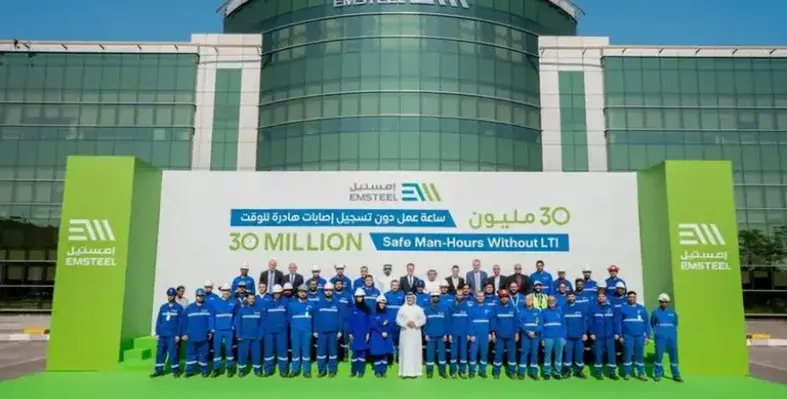
After reaching 30 million hours without a Lost-Time Injury (LTI), an event at the EMSTEEL Headquarters in Abu Dhabi saw the announcement of a new digital assistant, the HSE AI Advisor
The last recorded LTI across EMSTEEL sites was in September 2024; leadership team members and key stakeholders celebrated the 30 million hour milestone.
Group CEO Eng. Saeed Ghumran Al Remeithi said, "Achieving more than 30 million LTI-free man-hours reflects the commitment, vigilance and shared responsibility demonstrated by every member of our workforce. Safety is the foundation of our operational excellence and remains central to our long-term success."
At the ceremony, EMSTEEL unveiled HSE AI Advisor, a new digital assistant that provides real-time HSE guidance across all plants and employee departments. Al Remeithi continued, "The launch of the HSE AI Advisor strengthens this commitment by giving our teams a powerful new tool that enhances access to critical safety information and supports the consistency of our standards across the organisation.
"As we continue to invest in our people, systems and technologies, we remain focused on building a safer, more resilient organisation and setting higher benchmarks for industrial safety across the region."
The digital tool includes the latest regulatory information and HSE procedures in multiple languages. Employees at the event, which took place at EMSTEEL's headquarters, took part in a live demonstration of the new platform.
In October, EMST£EEL won the Safety Culture and Leadership Award at the worldsteel awards.