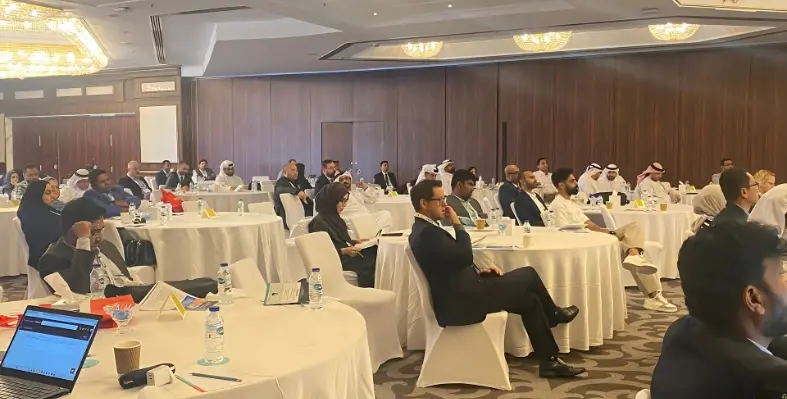

Well-crafted laws act as society’s primary safeguard, said Ibrahim bin Ali Al-Mohannadi, Minister of Justice and Minister of State for Cabinet Affairs, while speaking during a lecture at the Police Academy for the third cohort of the Security Leadership and Staff Programme
Attended by senior officers and Academy leadership, the talk explored how the legal system underpins daily security operations.
Al-Mohannadi pointed out that Qatar’s Permanent Constitution intertwines the rule of law with the state’s duty to maintain stability and safety, noting that lasting security relies on solid legislation just as effective laws depend on a secure environment.
Opening his remarks, Al-Mohannadi noted that crime prevention starts at the legislative level rather than at the scene of an offense, reinforcing the idea that strong laws form the bedrock of public protection.
He linked the country's legal framework directly to the Qatar National Vision 2030 and the Third National Development Strategy (2024–2030). Pointing to the 2026 Global Peace Index, he highlighted Qatar’s position as first in the Middle East and North Africa, 31st out of 163 nations worldwide, and seventh globally in societal safety and security.
According to the Minister, maintaining these high standards during an unusually turbulent year for the region is the direct result of clearly defined legal mandates and pre-established authorities. Addressing the mechanics of policing, he explained that operating strictly within the law empowers officers rather than restricting them. Proper legal procedures hold up in court and produce valid evidence, he said, stressing that the integrity of the very first step in a criminal investigation dictates the success of the entire judicial process.
Al-Mohannadi also reviewed constitutional protections for individual rights and freedoms alongside the three core standards that must govern any security action: legality, necessity, and proportionality. He noted that while modern tools like smart surveillance expand the reach of law enforcement, they do not exempt officers from these foundational rules.
Turning to upcoming reforms, the Minister spotlighted Amiri Decision No. 38 of 2026 on regulating legislative drafting, set to take effect on January 1, 2027. This decree transitions the government from creating laws simply to fill immediate gaps toward evaluating their broader, long-term impact. Under this approach, lawmakers must weigh security implications and verify that enforcement agencies have the necessary staff, training, and systems ready before a new law goes live.
He further underscored the value of public transparency and civic participation through Qatar's legal portal, "Al Meezan," and its interactive platforms, "Shawir" (Consult) and "Aqtarih" (Propose). Urging the attendees to submit feedback from their fieldwork, he remarked that a single practical observation from an officer on the ground can outweigh a lengthy theoretical study. He also praised the adaptability of Qatari law in tackling modern threats and cross-border challenges, referencing the Anti-Cybercrime Law and Law No. 17 of 2026 on international treaties, which enables judicial cooperation beyond national boundaries.