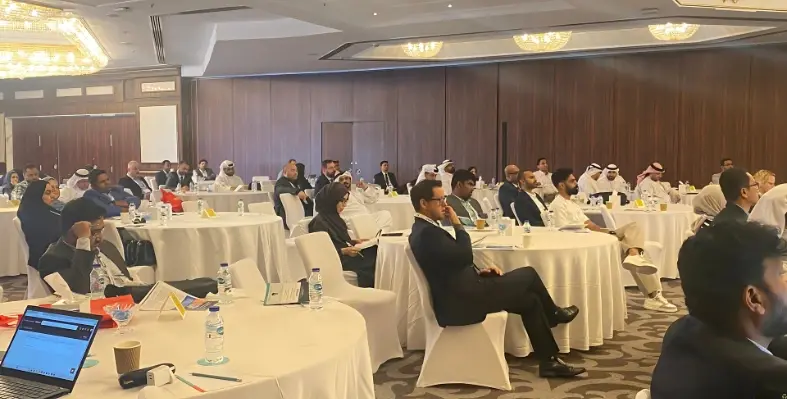
At HSE MENA 2025, held in Dubai, Ihab Al Bairam, AVP Community Management, DAMAC LOAMS, gave a presentation on ‘From compliance to commitment: empowering leaders to shape a proactive safety culture.’
Al Bairam began by highlighting some of the characteristics needed for safety leadership, emphasising the importance of mindset and ownership. In fact it was these qualities that had led him to be promoted from facilities management engineer to his safety leadership role. Safety leaders should also have the ability to transfer the culture of health and safety throughout the organisation.
“Safety is not a policy, it’s a mindset,” he said, stressing the importance of ensuring that the culture of safety as a priority needs to be clearly developed within the organisation and within the core team.
“Once you have that, you need to drive it by showing how the safety culture will benefit your organisation,” he went on. For example, by reducing incidents, motivating employees, improving performance and enhancing efficiencies by making processes leaner and more proactive.
“This will help to justify your operations and processes to the board as well as your team on the ground. It is critical for there to be an understanding of the benefits and drive behind the safety culture which you are trying to establish within the organisation. “
Establishing such a culture is a collective responsibility, he went on. “You can’t act like a one-man show, you need a team behind you which believes what you are building and trying to drive within the organisation. Each team member should have his role, responsibility and accountability for you to achieve your targets.”
Driving the safety culture
Elaborating on the role of safety leadership, Al Bairam went on to highlight four elements needed for a leader to be able to drive the safety culture. The first is to have a vision and mission, the second is to be a role model, who is visibly developing the health and safety culture within the organisation. Third is the need to ensure that rules and responsibilities are made clear throughout the organisation “so each team member knows his responsibilities, what he needs to do, where he needs to act and how he should perform to ensure that health and safety along with day-to-day operations is running smoothly.” Fourth is open communication and reporting. “Your door should be open for team members to report both big and small things. That way, they feel their concerns are acknowledged and listened to.
“Safety culture is not about health and safety processes and procedures, it’s around how we should develop the culture within our team and our organisation,” he stressed.
For the safety culture to be disseminated throughout the organisation and to all its stakeholders, key factors needed are leadership commitment, training and awareness, accountability and transparency of communications, keeping up with technology and market developments, recognition and rewards, continuous learning, development and improvement of processes.
Empowering teams
Al Bairam went on to discuss how to build and improve safety culture across the organisation.
“We need to ensure we are empowering our operations team – not the managers and engineers but the supervisors, workers, technicians, cleaners, security; those are the people who are our eyes on the ground,” he said.
Speaking about DAMAC Properties he said, “Today we are managing around 100 builds across Dubai, and the main eye we have is the security. If I didn’t empower the security to take the right decision, if I didn’t providing them with the training and the processes, our health and safety would collapse. A small fire could spread within minutes if the security didn’t know how to act. The same thing if the cleaner saw the fire and ran away without reporting it.
“Empowerment is not just about delegating responsibility, we need to give guidelines, tools and training on how to act in an emergency.”
He also highlighted the need for integration between operations and health and safety, which can be built through strong processes across the teams, and collaboration and trust between the operations and health and safety teams. “Our organisation has this integration in its DNA,” he said.
“Now we understand health and safety culture and how it should be developed within the organisation, to get to the next level, we need to have a proactive mindset,” he continued.”To develop this we need to encourage open discussion and ensure that near misses are given as much attention as accidents and incidents. Training and continuous learning will also help the team to think proactively to prevent failures.”
Giving more insight about how to empower teams, Al Bairam gave the example of the issue of a work permit, which does not necessarily need to be issued by the health and safety expert, but can be issued by the technician on the ground if he is trained and empowered to do this. “This can happen if you have the right health and safety culture and the leader who is empowering the staff to have the health and safety culture within their organisation, where all the employees within the organisation act like a health and safety officer. We can have this by having training, setting accountability rules and responsibilities, having a proper process and encouraging open communications allowing them to raise their questions and concerns without hesitation.”
On recognition he said, “We need to see the technician the cleaner, the security who is actively protecting our assets to be recognised.”
Finally he stressed that the health and safety leader should push hard to ensure that his function is regarded as a key role rather than a support function, by demonstrating the benefits he brings to the organisation.
“You need to push yourself as a main and core key player within the organisation to have the health and safety culture run across the operation.”