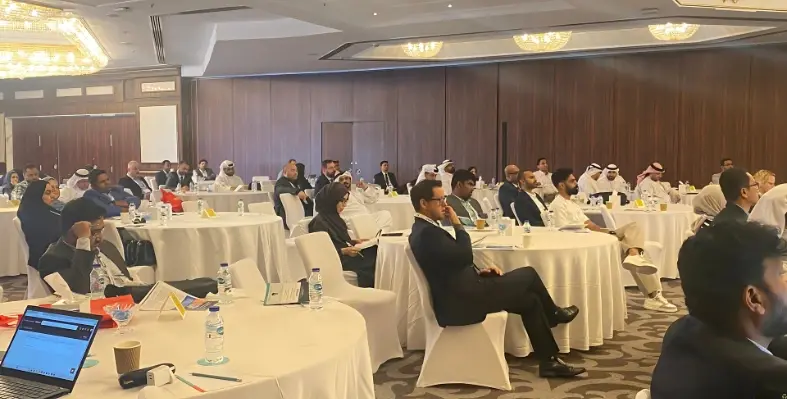
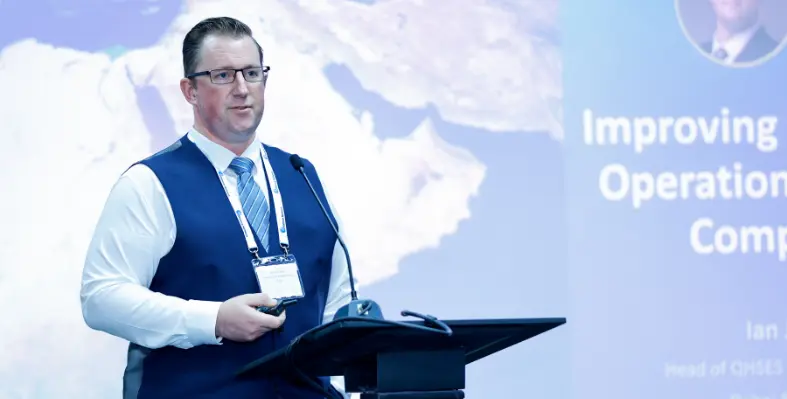
In a thought-provoking presentation at the HSE MENA 2025 conference, Ian Welsh, Head of QHSES and Special Projects, laid out a vision for improving operational Health, Safety, and Environment (HSE) compliance across the MENA region.
Drawing on his decade-long career in Australian construction, followed by years of leadership in the United Arab Emirates, Ian emphasised the critical need for authentic leadership and tailored coaching in the quest to elevate safety standards in a rapidly developing environment.
Ian began by underscoring an oft-overlooked truth: everyone in the field – regardless of title – plays the role of a health and safety leader. The challenge, he argued, lies not just in adhering to technical standards, but in influencing a diverse workforce, much of which arrives from neighbouring countries with minimal HSE exposure. Rather than adopting a punitive approach, Ian called for empathy and cultural understanding, highlighting that many workers are adapting to higher safety standards for the first time.
Central to his strategy was a three-pronged approach: coaching HSE staff, fostering meaningful engagement with the workforce, and ensuring operational practicality. Ian’s method moves away from mere instruction and compliance. Instead, he champions authentic leadership that is present, empathetic, and invested in the growth and effectiveness of HSE professionals. “If a craftsman wants to do good work, he must first sharpen his tools,” he quoted, reinforcing the need for continuous development of the people on the ground.
A significant portion of Ian’s remarks reflected findings from his recent MBA research dissertation, which surveyed and interviewed HSE professionals across the region. He identified a pronounced gap: while HSE managers and officers understand their technical duties, they often struggle to align these tasks with broader corporate objectives. Moreover, most operational HSE professionals lack access to strategic leadership and effective coaching, leaving them isolated in demanding environments.
Ian’s answer lies in servant leadership, a model where leaders support and develop their teams by example, providing individualised guidance and public recognition for achievements. He highlighted the importance of adapting safety practices to operational realities, especially in fast-paced sectors such as construction and event management. “A safe running project,” he remarked, “is a fast-moving project.”
The ripple effect of such leadership, Ian argued, extends well beyond immediate teams. By empowering HSE professionals and engaging workforces respectfully, companies elevate not only internal standards but contribute to the regional adoption of best practices. Ian closed by urging continued dialogue and feedback, inviting attendees to participate in an anonymous survey to share their perspectives, thus fostering an ongoing culture of improvement in MENA’s HSE landscape.