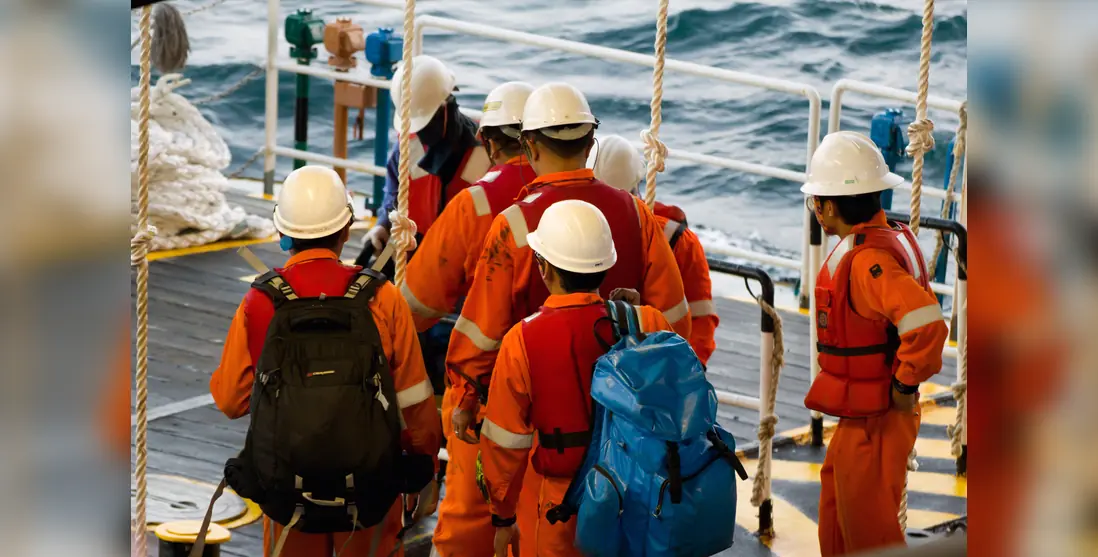
Offshore employers are being urged to identify and support workers who could be affected by new industry weight restrictions impacting the UK offshore industry, with a mandatory 124kg clothed weight limit due to come into force on 1 November
From that date, anyone exceeding the limit will not be issued a standard medical certificate and will not be permitted to travel offshore, potentially affecting their ability to work.
This industry-wide Safe Weight Limit Policy has been developed following extensive engagement between OEUK, HM Coastguard, helicopter operators, and member companies and is in place to ensure the safety of all personnel working offshore. It addresses increasing worker weights and the associated challenges for evacuation, rescue, and medical response offshore, as search and rescue helicopter winches have a limited capacity for a single patient. The combined load of the winchman, stretcher and equipment leaves a maximum capacity of 124.7 kg for a patient. Anyone above this weight cannot be guaranteed rescue by search and rescue (SAR) helicopter. The new policy ensures every person can be safely evacuated or rescued, particularly by SAR helicopter winch. The policy applies to all offshore installations operating under accepted Safety Cases as defined in the Offshore Installations (Offshore Safety Directive) (Safety Case etc.) Regulations 2015. It does not apply to marine vessels, which are governed by different regulations.
Employers are encouraged to provide access to weight-management and wellbeing programmes, and pointers to support and advice are given on the OEUK website. Workers affected are advised to take healthy steps to lose weight, such as changing diet, exercising more, and seeking medical advice where required to ensure they can lose weight in a healthy, safe and sustainable manner.
Aberdeen occupational health specialist International Medical Management (IMM) is encouraging companies to act now rather than wait until an employee’s next medical or mobilisation.
Dr Louise Slaney, medical director at IMM, said, “Although November may still seem some way off, employers now have only a relatively short window in which to identify potentially affected workers and put appropriate support in place.
“Waiting until October, an employee’s next offshore medical or the point of mobilisation could leave too little time for weight reduction to be achieved safely and sustainably.
“From November 1, someone arriving at the heliport weighing more than 124kg fully clothed will not be able to travel offshore. For the individual, that could mean being unable to go to work; for the employer, it could create an unexpected gap in the crew at the point of mobilisation.”